

Hello, on another Monday in sunny Queensland. Or not sunny, depending where you are in Queensland. In fact it’s raining quite heavily in my part of the world.
Either way, wherever you are, I hope you’re having a great morning, afternoon or evening.
I wrote about the benefits of green tea over a year and a half ago now, and I reread that post the other day. Which got me thinking that I should revisit it as I’ve learnt more about the benefits of green tea. I’ve tried a lot of different green teas, so I thought I’d share my favourites in case you want some pointers. Damn, I’ve turned into a green tea nerd. Perhaps I should refer to myself as a connoisseur rather than a nerd. Then again maybe neither. I’m just someone who likes green tea and has a tiny amount of knowledge on it.
If you want to read my original post on green tea you’ll find it here: Hello, I’m Back, And Green Tea
I mentioned some of the benefits of green tea in that post so I’ll try not to repeat myself too much. However, I will try and expand on what I wrote before just to pass on more knowledge. I’ll also provide some links at the end so that you can check out the research yourself if you want to delve deeper.
Before I start though just remember there’s no magic bullet for cancer. If one single thing could cure cancer we’d all be doing it. So green tea on its own won’t cure cancer. However, if you make it part of your arsenal in fighting cancer you’ll find that it helps a lot. It’s great to incorporate it into an holistic approach in the march towards full remission. As such it’s a great preventative to drink in order not to get cancer in the first place. It can’t do you any harm, unless you drink ridiculous amounts as it does contain caffeine.
Green tea contains a substance called EGCG, or to give it the full name epigallocatechin-3-gallate. It is a polyphenol and green tea is rich in them. However, EGCG is the most abundant making up about 50% of them.
I’ll try and keep the medical stuff simple. Believe me I struggle to read a lot of research papers as I’m not medically trained. There is a lot of research but medical and scientific papers are a world unto their own. I don’t understand a lot of the medical terminology, although I’m getting better. A lot of it you probably won’t be told by your oncologist, or the specialist you are seeing, unless they are amazing. And some are amazing, but some are not. You have to ask questions and even then you may not get answers. However, once you get some pointers in the right direction there is a mine of information out there. Then you just have to wade through the crap until you find the gold mine. Once you find that it’s incredible what you can find out to help you overcome this disease and support your healing treatment.
It very much is a case of doing research, asking questions, doing more research. Finding the specialists in their fields who understand all this, asking more questions and doing more research. But when you’re trying to save your life, or someone elses, it’s worth it.
Many serious diseases are linked to inflammation in the body as well as inflammation-induced oxidative stress. How this then effects the body can get complicated, and if you like the complicated stuff, or you’re a bit of a biological detective I’ll provide links at the end for you to delve deeper. It’s worth it but it takes time and brain power. So for my post I’m keeping it simple…ish.
Ok, here we go. It’s been proven that inflammation and oxidative stress, in the body, have a detrimental effect on your health. They play a large part in cancer, cardiovascular diseases, diabetes, kidney disease, and respiratory conditions. They can also play a part in mental health issues, such as depression. This list isn’t everything but you get the idea. Too much inflammation and oxidative stress in the body is bad for you. Add this to everything else that can cause major diseases and the pieces of the puzzle start to fall into place as to why so many people get ill.
What causes this is probably a post unto itself, but there is a lot of information out there if you want to look for it. Very briefly the following can cause a problem: stress, lack of exercise, poor diet, being over weight, visceral fat, exposure to toxins, tobacco, alcohol and disrupted sleep. There is more but you’ll have to do your homework as I want to get back to green tea.
A lot of research now shows that there are natural products which are high in antioxidants and can successfully counteract the progression of inflammation in the body. Green tea being one of them.
EGCG, from green tea, has shown to have anticancer, anti-inflammatory, vasoprotective, antifibrotic and antioxidant actions.
Let’s stick to green tea and cancer though. That’s what I have and that’s what I understand. Again do your homework. There’s plenty of research out there on all the above diseases.
Green tea can help stop the spread of cancer. It can also help stop the self-renewal pathways of cancer stem cells, which is massively important. Cancer stem cells are different to normal cancer cells. Chemotherapy, for example, can kill all cancer cells except cancer stem cells. This is one of the reasons people can come out of full remission. Cancer stem cells can go dormant during the chemo process only to reactivate months or years later. If you look at them like bees, then cancer stem cells are the queen bee and normal cancer cells are the workers. You can kill all the workers but if you don’t kill the queen then eventually she will create a new hive, and new workers. This why people often have stem cell transplants, and these can be successful. But not always and sometimes, for a variety of reasons, people can’t have them.
Clinical research has shown a lot of great results with EGCG from green tea. Studies have shown that it reduces blood cancers, causes reduction of cancer in the lymph nodes, has caused cancer regression in chronic lymphocytic leukaemia, reduces the development of prostate cancer, helps prevent breast cancer and breast cancer reoccurrence, and reduces metastases in a number of cancers. There’s more but this should help you get started with your own research.
Added to all this, and something I’ve looked at in-depth, EGCG is a chemotherapy sensitiser. This means that it can reduce some of the side effects of chemo as well as helping it to work better.
EGCG scavenges free radicals, reduces oxidative damage, is not toxic to normal cells, it combats the drug resistance of cancer stem cells, alleviates adverse side effects such as nephrotoxicity and decreases the development of cachexia.
There you go. I think that should be enough to get you started on green tea. Even if you choose not to look at any other research at least drink some green tea. Even if it’s just for the simplified reasons I’ve given above. It’s good for you and if brewed correctly is very refreshing. Not to mention that some research shows it can help you lose weight. I bet that statement’s pricked a few ears up.
Hang on, I hear some of you say, but which green tea and how do you brew it for the best results. How much should you drink for it to be effective?
Easy answer first. You should drink about four to five cups a day to get the most beneficial effects. I do this easily, a cup isn’t that big. If you have a decent sized mug it probably has two to three cups in it. So if you have two mugs a day you’re probably doing alright.
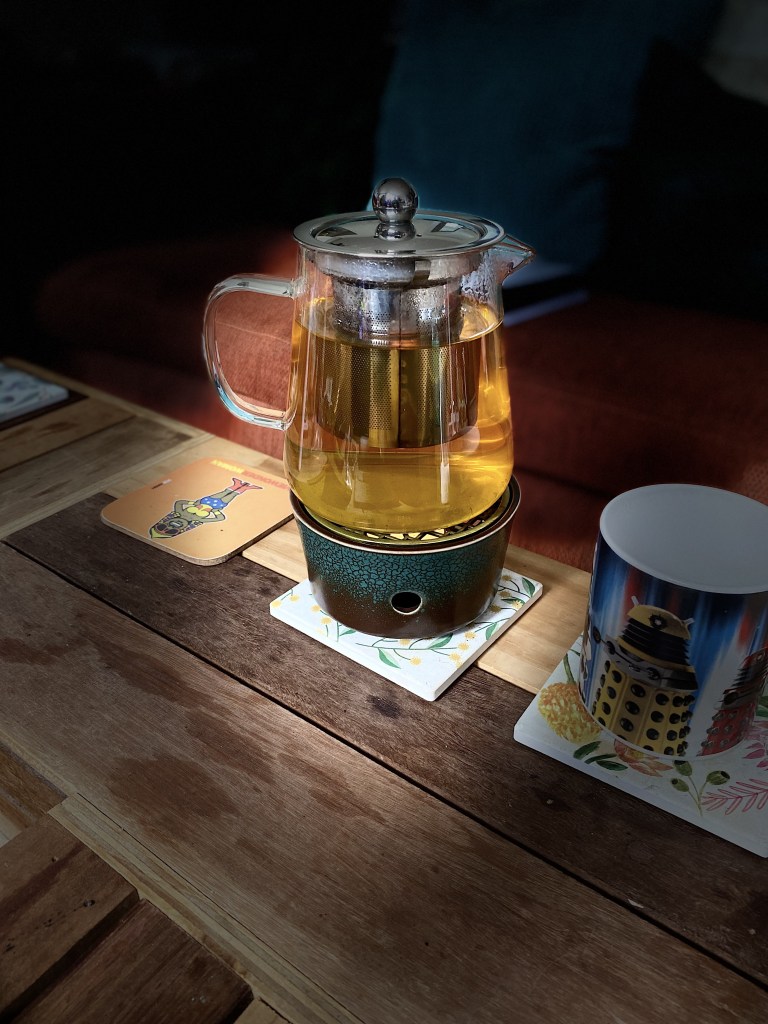
The photo at the start of the article is mine. The teapot in the photo probably holds four cups. That is a guess but an educated guess. I’ll drink that in one sitting and probably do it twice a day. That’s my daily intake covered right there. As you can see it’s not difficult to drink enough.
If you really don’t like the taste of any green teas then take a quality supplement. I take one as well as drinking the tea. It contains 416 mg of EGCG. A cup of brewed green tea contains about 200 – 300 mg of EGCG. You do your maths and work out what you need.
As always if your not sure if it’s compatible with your treatment, has contraindications, you possibly have allergies, etc then check with a qualified health professional if it’s ok for you to have it. For most people it should be fine, but if you’re not sure then it’s best to check.
Green tea is a slightly different brewing process to black tea too. Green tea should be brewed at 80ºc (176ºf). I’m lucky, I’ve got a kettle with the temperature on it so it’s easy for me. I boil the kettle then I just keep an eye on the gauge until it drops to 80º. I’ve timed it too for those that don’t have a gauge. If you flip the lid open it takes about ten minutes to cool down to the desired temperature. If you don’t flip the lid allow about fifteen mins. Of course this could vary from kettle to kettle, but I know you’re smart and you are more than capable of working it out. It’s worth it because it tastes a lot better if you brew it at the right temperature. Not to mention you get the maximum health benefits. It’s worth being a little patient, trust me on that one.
Interestingly when it comes to the ideal brewing temperatures of other teas then oolong is 85ºc (185ºf), black tea is 100ºc (212ºf) and white tea is the same as green. Oh and coffee is apparently 95ºc (203ºf). Of course people may disagree but it’s only a rough guideline from what I’ve researched.
I’ve discovered that green tea varies a lot. Some are a lot stronger in taste than others and the flavours can be different. So you need to experiment and find the ones you like. I use loose leaf in a pot because I find it’s better all round. Tea bags are ok but for me they just don’t cut it.
My favourite green teas are, in no particular order, sencha, misty green, jasmine, gunpowder and buddha’s tears. I also like high mountain oolong tea and pu-erh tea. Pu-erh has health benefits too and is a fermented tea that is sold normally as a compressed tea cake or brick. Pu-erh is a new discovery for me and is a whole new world of tea. I’ll leave you to look it up for yourself.
That’s green tea revisited. I hope it’s given you some insights and maybe even inspired you to try something different. Oh, and don’t add dairy milk as apparently the research shows that it destroys the properties of EGCG, and you don’t want that.
It must be links time. Just click on them and it will take you straight to the website.
In Australia I buy tea from a couple of different places. Here’s two of them:
Valley Green Tea: https://www.valleygreentea.com.au/
The Tea Centre: https://www.theteacentre.com.au/
Now for the medical links. Some are user friendly and relatively easy to understand. Others are a little more complicated and take a lot more concentration. See how you go. I’ll put one in at the end about inflammation too as it’s a good place to start on that subject.
Cancer Active: https://www.canceractive.com/article/green-tea-chronic-illness-and-cancer
National Library of Medicine: https://www.ncbi.nlm.nih.gov/pmc/articles/PMC9820274/
American Botanical Council: http://cms.herbalgram.org/herbclip/451/021233-451.html?ts=1540523722&signature=b8c686a4d60f28fcef49eb6e897b5bc0
Cleveland Clinic (inflammation): https://my.clevelandclinic.org/health/symptoms/21660-inflammation
Now after all that I’m off to make a pot of green tea. Happy drinking, stay healthy and love life.
Cheers, Jon
 The Cancer Raven
Pingback: Green Tea Part 3. The Science. The Video. – The Cancer Raven